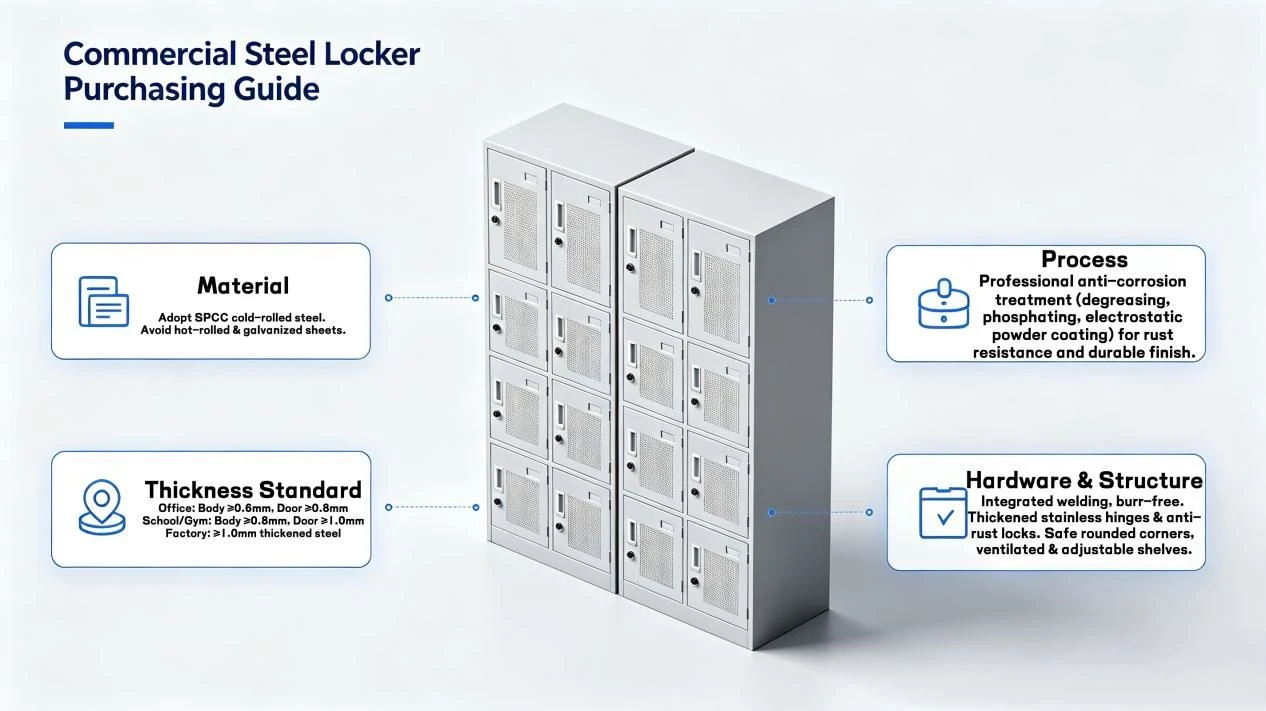
Material is the foundation of durability. For commercial scenarios, it is essential to select SPCC high-quality cold-rolled steel sheets, and avoid hot-rolled sheets prone to rust and galvanized sheets prone to paint peeling. Purchasers must verify the bare steel sheet thickness (excluding powder coating) to prevent false labeling by suppliers. The thickness specifications are as follows: for general office scenarios, the cabinet body shall be no less than 0.6mm and the door panel no less than 0.8mm; for high-traffic scenarios such as gyms and schools, the cabinet body shall be no less than 0.8mm and the door panel no less than 1.0mm; for heavy-duty factory and workshop environments, thickened steel sheets of 1.0mm or above are required to ensure load-bearing capacity and prevent deformation.
Craftsmanship determines the service life of cabinets. High-quality commercial cabinets undergo a complete anti-corrosion process including degreasing, derusting, phosphating and electrostatic powder coating, delivering strong paint adhesion and long-term resistance to rust and paint peeling. In contrast, low-quality cabinets with simple spray painting will suffer from edge rusting and paint shedding after short-term use, making them completely unsuitable for long-term commercial application.
Details and hardware are the key to long-term stable performance. Cabinets with full integral welding structure are preferred, featuring burr-free surfaces and tight splicing. Equipped with thickened stainless steel hinges and rust-proof durable locks, they ensure smooth opening and closing without jamming or door sagging. Meanwhile, humanized designs including ventilation holes, rounded corner chamfers and adjustable shelf panels adapt to diverse scenarios, balancing safety and practicality.
Avoid two major purchasing misconceptions: do not blindly pursue low prices, as low-cost thin-sheet cabinets come with extremely high failure rates; do not excessively over-specify thickness, and select models based on actual needs to avoid budget waste. Conduct simple acceptance checks upon delivery by verifying sheet thickness, manufacturing craftsmanship, hardware smoothness and overall cabinet stability. The optimal purchasing criteria for commercial steel lockers cover scenario adaptability, compliant materials, standardized craftsmanship and premium hardware.