Many people have a doubt when purchasing steel furniture: for identical iron cabinets, steel beds and storage shelves, why do some pieces peel, rust and get covered in scratches after just two or three years of use, while others remain brand-new, scratch-resistant and durable for a decade?
Aside from steel thickness and workmanship details, the core factor that determines the service life of steel furniture lies in the surface treatment process.
Currently, electrostatic powder coating is the top-tier process universally adopted for high-quality steel furniture. It outperforms traditional liquid paint spraying by a wide margin and serves as the core technology behind big-brand steel furniture's outstanding performance in rust resistance, wear resistance, environmental friendliness and long-lasting appearance. This article provides an easy-to-understand breakdown of this professional industrial technology to help you grasp the key to steel furniture quality.
1. What Is Powder Coating? How Does It Differ From Ordinary Paint Spraying?
Simply put, powder coating is a solvent-free, fully solid and eco-friendly metal surface finishing technology.
Traditional paint is liquid and requires thinners and solvents, containing high levels of harmful substances such as VOCs, benzene and formaldehyde. The paint film formed is thin with tiny pinholes, allowing water vapor to penetrate easily, which leads to rapid rusting and scratching.
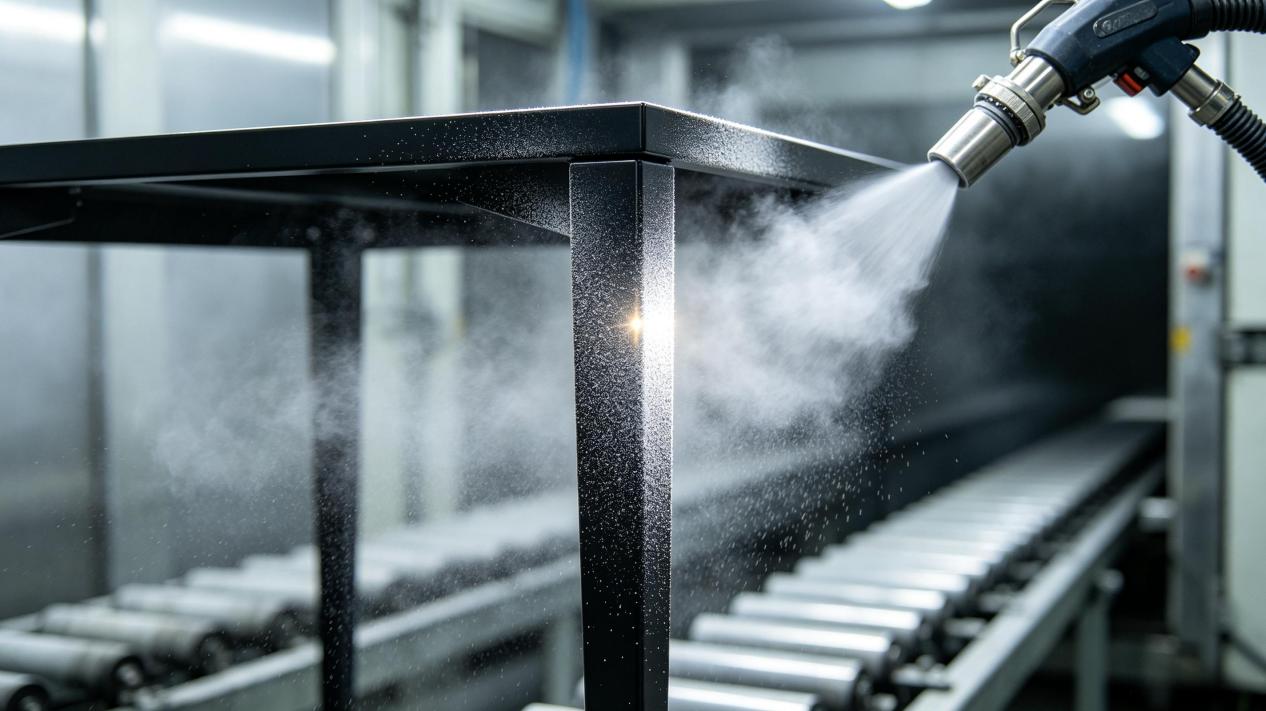
In contrast, powder coating uses solid powder paint. The powder adheres to the steel surface via electrostatic adsorption, then melts and cures at high temperature to form a thick, dense and tough protective film. It has become the standard premium process for office steel furniture, industrial steel storage products and outdoor metal furniture.
2. Complete Powder Coating Process: 4 Core Procedures for Superior Quality
Many people mistakenly believe that powder coating is simply "spraying powder and baking". In fact, the standardized full process, especially the easily overlooked pre-treatment procedure, determines the rust-proof and scratch-resistant performance.
2.1 In-depth Pre-treatment: Most Critical Step
Steel is prone to oxidation and rust. Without proper substrate treatment, even high-quality powder coating will fail, resulting in paint peeling and rust recurrence in the later stage. The standardized process includes refined multi-step treatment:
Degreasing & De-oiling: Thoroughly remove residual machine oil, grease and hand stains generated during steel plate stamping and bending, eliminating the risk of paint delamination.
Multi-stage Water Rinsing: Flush away residual chemicals layer by layer to avoid steel corrosion caused by acid-base residues.
Rust & Oxidation Removal: Eliminate oxide scales, rust spots and blackened layers to achieve a clean and pure substrate surface.
Phosphating Film Formation: Generate a dense chemical conversion film on the steel surface. This film directly isolates air and water vapor for primary rust prevention and greatly enhances powder adhesion to ensure the paint film fits tightly on the steel plate.
Drying & Dust Removal: Ensure the substrate is completely free of water, oil and dust, laying a perfect foundation for subsequent spraying.
2.2 Electrostatic Powder Adsorption: Uniform and Full Paint Film
Based on the high-voltage electrostatic principle, the powder is negatively charged while the grounded steel workpiece is positively charged. Through positive and negative charge adsorption, the powder evenly covers all parts of the furniture, including flat surfaces, edges, welds and inner cavities.
The standard coating thickness reaches 60-100μm, 2 to 3 times that of ordinary paint spraying. Excess powder can be recycled and reused with a utilization rate of over 95%, delivering better quality while being more energy-saving and eco-friendly.
2.3 High-temperature Curing & Baking: Form a Rigid Protective Layer
The powdered workpiece is sent to a constant-temperature oven and baked at 180-200℃ for 10-20 minutes. During this process, the powder first melts and levels out, then undergoes chemical cross-linking and curing, transforming from loose powder into a continuous, smooth and rigid paint film.
This step directly determines the hardness, toughness and adhesion of the paint film. Cutting corners with low temperature or insufficient baking time will result in soft, easily scratched and peel-prone paint surfaces.
2.4 Precision Quality Inspection
After natural cooling, workpieces are strictly inspected for color difference, missing spray, pinholes, flow marks and poor adhesion. Defective products are eliminated to ensure uniform texture and intact paint surface for all finished furniture.
3. Two Core Types of Powder Coatings for Scenario-specific Application
Steel furniture for different scenarios is matched with dedicated powder coatings to adapt to diverse service environments:
3.1 Epoxy Powder (Indoor Use)
It features excellent adhesion, superior rust resistance, acid and alkali resistance, high coating hardness and cost performance. Its only drawback is poor UV resistance, which causes powdering and fading outdoors. It is ideal for indoor steel furniture such as file cabinets, lockers, steel beds and storage shelves.
3.2Polyester Powder (Outdoor Use)
Its core advantages include UV resistance, anti-aging performance, color fastness and excellent weather resistance. It resists yellowing and powdering during long-term outdoor exposure, making it suitable for outdoor storage cabinets, steel frames and outdoor metal tables and chairs. Its rust resistance is slightly lower than that of epoxy powder.
4.Avoidance Guide: Distinguish Standard Technology From Inferior Spraying
Many low-cost steel furniture products claim to adopt powder coating but cut corners in production. Watch out for the following flaws when purchasing:
Omitted degreasing and phosphating: Inadequate substrate treatment leads to early paint peeling and weld rusting.
Insufficient coating thickness: A film thickness below 40μm greatly compromises wear and rust resistance.
Low-temperature rapid baking: Incomplete powder curing results in soft, easily scratched and dust-adhesive paint surfaces.
Mixed inferior recycled powder: Causes surface pitting, severe color difference and rapid failure of protective performance.
Ultimately, the core value of steel furniture lies in its practical attributes of rust resistance, scratch resistance and durability rather than appearance design.
With the multiple strengths of environmental safety, hard paint film, long-term corrosion resistance and stable appearance, powder coating has become the core technical support for high-quality steel furniture. The standardized powder coating process eliminates the short service life and fragile defects of traditional steel furniture, maintaining a brand-new and durable state for years. It serves as the optimal choice balancing cost performance and quality for office, home and industrial storage scenarios.